Bilingualism
Since starting my professional career as a private Spanish teacher, I’ve had my good share of one-time students (via Outschool) including students that have taken only a few classes with me. I stopped teaching at Outschool to focus on more meaningful language connections with my individual students. Primarily focusing on third-generation Latino children reconnecting with their heritage language, Spanish. Just as I did with my own son, who is now bilingual.
I feel incredibly grateful and hold a special place in my heart for my long-term students, a group of amazing kids whose Spanish language growth I’ve had the privilege to witness firsthand. Watching them flourish in their language journey is truly rewarding. Of my 15 students, 9 of them have been with me from 2 to 5 years!
I’ve seen incredible transformations, like one student, 8-years-old, in our first class told that she doesn’t know why she has to learn Spanish, and now, as a bright 12-year-old, she’s on her way to becoming bilingual.
In this journey, I’ve had plenty of laughs too. Especially when they start translanguaging, and tapping into their bilingual brain.
For example, a student in his excitement thought he knew a word. We were reviewing house vocabulary words. He took the first syllable of “co-cina” (kitchen) and the last syllable of “ba-ño” (bathroom) and blurted out: “It’s “coño!” After laughing out loud, I told him that “coño” is a common slang expression in many Spanish-speaking countries, often used to show strong emotions like surprise or frustration. But this word can also be considered impolite or vulgar, and he shouldn’t repeat it or say it again.
Nonetheless, I am delighted that he tapped into his full linguistic repertoire, creatively combining syllables to form what he thought was the word, only to unintentionally produce one with an existing, and unintended meaning. It is fascinating how bilingual speakers mix and manipulate language dynamically to express themselves!
Or the time, I was teaching the soft “c” and showed my student a picture of a “cerdo” (pig) and he blurted out “chicharrón” (pork rinds). Like really? Hahaha I could tell he loves chicharrón. This is the same student who didn’t know any Spanish when he started taking lessons with me and he is now having full conversations in Spanish with his Abuela in the Dominican Republic.

However, my proudest moment has to be when my 7-year-old student (whom I began teaching Spanish at age 3) confidently served as an interpreter, translating for an adult in front of a group of both adults and children in Spanish!
This is exactly why I started teaching Spanish, to help parents support their third-generation Latino children in reclaiming their heritage language. And in the process, I’m helping other children become bilingual as well.
All this to say that language learning takes years, not just months or weeks, and I’m truly grateful for the parents’ support throughout this journey.
I’m looking forward to many more laughs, proud moments, and seeing my students shine bright as they acquire and grow in their Spanish language skills. It is a true honor to be part of their language learning journey.
Bilingualism Resources
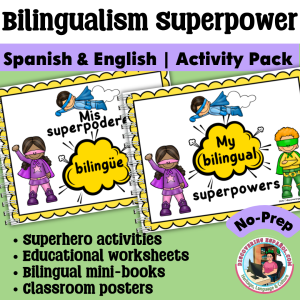
Do you want to inspire and motivate your own bilingual learners? You’ll love this activity pack or the free bilingualism posters.
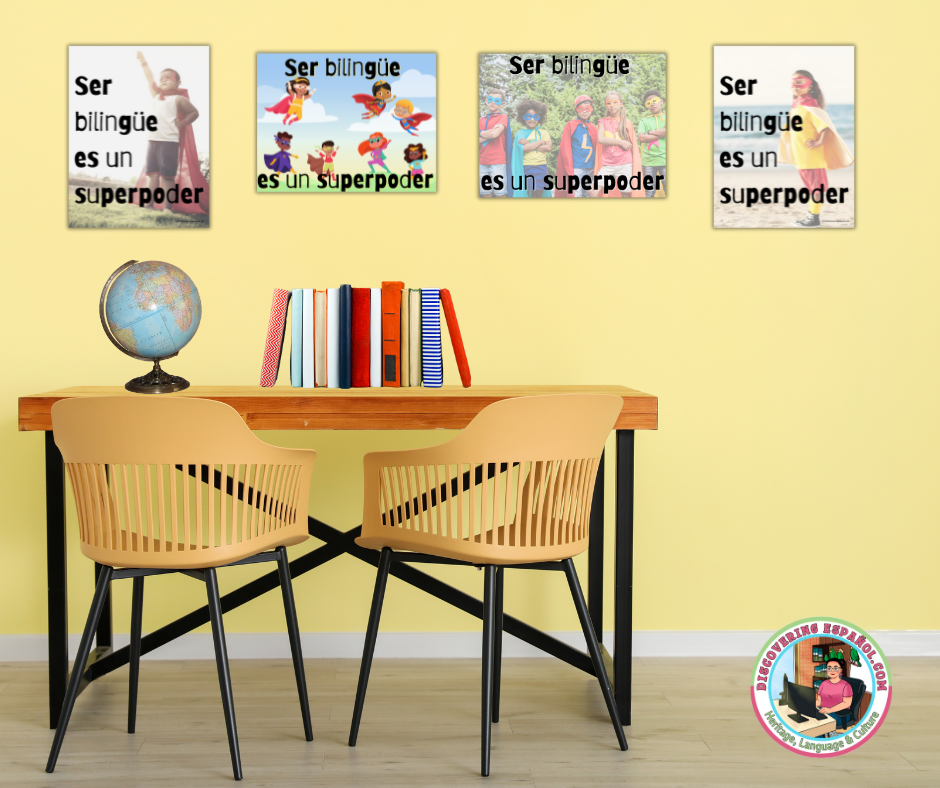
These posters would look great on your classroom or kids walls.
Related posts:
Bilingüismo: Desafiando las expectativas en un entorno monolingüe
Rolling your R’s 10 Super Amazing Tips
Pin for later!